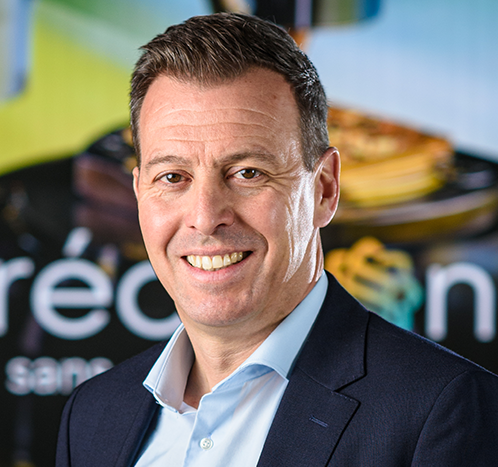
Moving from investment banking to industry often means choosing international competition, up against tough adversaries. That is the decision Nicolas Curty made in his thirties, after an initial career phase dedicated to corporate financing.
It was the business leaders he met during that period who inspired him to join Affolter SA, a manufacturing jewel of the Bernese Jura — the French-speaking part of the canton of Berne, historically tied to watchmaking and microtechnology. A maker of watch gears, among other things, but also a designer of the machines used to produce them, this family-owned group founded in 1919 is a winning example of an evolution built on anticipating future challenges without sacrificing an extraordinary standard of quality.
In this interview, Ad Valoris asks Nicolas Curty about his career, closely intertwined with that of Affolter SA, whose interests he has led for many years.
Nicolas, what leads a man from Swiss banking to choose industry?
Banking was really just a professional parenthesis. I studied business economics at the HEG in Neuchâtel, which pointed me more toward production than finance. That said, I learned a great deal from that first experience. But I quickly returned to a world more in line with my family tradition.
21 years after your first steps at Affolter SA, you now lead its destiny. Why such loyalty?
It is a century-old family business with a solid shareholding structure that embraces the idea of long-term development. We run many projects, regularly intervene along our value chain to optimise our processes, design new products, and enter new markets. This dynamism from the Board fosters our culture of openness. With around 200 employees, we prioritise stability and uphold the tradition of quality that is distinctly Swiss. Like any company, we have weathered crises, but the loyalty and commitment of its human element — from the workshop floor to the governing bodies — has always been a bulwark against difficulties.
You are not a member of the owning family. How do you manage to maintain the necessary neutrality and firmness?
Rule number one is to put the company’s interests first. The maturity of the shareholders, who regard Affolter SA as a member of the family, is a key enabling factor.

Why do humanoid robot manufacturers find you interesting?
We are a leader in gears for high-end watchmaking and microtechnology. Our expertise is an added value for the humanoid robotics industry, for which we are developing specific know-how built on a century of experience. A hand, a joint, robot heads rotating 360° all function with gears — and we produce them. We are also active in other sectors with the same needs, including automotive, aeronautics, and defence.
What is your outlook for the next twenty years?
With what kind of products, for example?
The standardization of USB-C chargers is a very concrete example. Other standards we’ve developed in partnership with ISO and ITU affect daily life: JPEG, MPEG—for which we’ve received Emmy Awards, by the way. We also develop cybersecurity standards and frameworks for AI systems. And we set standards for smart grids, solar, wind, hydro power, and fiber optics.
Your cooperation with ISO is therefore essential?
Absolutely. Cooperation is one of our strategic pillars. The IEC and ISO are independent organizations, but we co-develop many programs—particularly in recent years around digital standardization. We also work with ITU and IRENA, the International Renewable Energy Agency. No single organization can tackle everything alone.
Is the IEC accelerating what we call “progress”?
Yes—our standards enhance technological compatibility, knowledge sharing, market access—and therefore investment. A globally recognized standard offers stability to investors. We help structure innovation and accelerate its diffusion, for everyone’s benefit.
So your presence is global?
We operate five regional centers—in Sydney, Singapore, Nairobi, São Paulo, and Boston—alongside our headquarters in Geneva. These small local teams are essential to staying attuned to regional realities.
With the rise of the BRICS, are you concerned about system fragmentation?
That’s precisely what we aim to avoid. The IEC must remain a global platform, independent of geopolitical tensions. Of course, our standards can be adapted locally, but we’re committed to preserving a shared foundation—even in times of crisis. So far, our mission has remained unaffected by such tensions.
Is standard development slowing down in today’s unstable world?
On the contrary—it’s accelerating. Artificial intelligence, for instance, requires entirely new standards. But let’s be clear: we’re not a moral authority. Our role is to provide a trustworthy, transparent foundation—sometimes enriched with ethical principles. We’re working with ISO and ITU on traceability, content authenticity, and certification. These efforts aim to restore trust. A major event on this topic—the International AI Standards Summit—will take place this December in Seoul, closely tied to the UN’s Global Digital Compact initiative.
How do you organize such a vast body of knowledge?
Each year, 30,000 experts contribute to the IEC. Our information systems manage this vast technical content transparently and across disciplines. We work in real time through our OSD (Online Standards Development) platform, which we share with ISO. All new projects are centralized there, improving access, inclusion, and efficiency. Today’s users expect “smart” standards—ones that can be directly integrated into systems. That’s the Smart Standards initiative we’re developing with ISO.
How do you fund your activities?
Through contributions from our Members and from our Conformity Assessment Systems. We also sell our standards to help finance operations. As a non profit, any surplus is reinvested, notably into our digital transformation.
And if you had a magic wand?
I’d use it to make an “all-electric and connected” society possible. Today, hundreds of millions of people still lack access to safe electricity. If I could, I’d make that model accessible everywhere. Not to create dependency—but to foster harmonious global development.

“We help structure innovation and accelerate its diffusion, for everyone’s benefit.”
Philippe Metzger, Secretary-General and CEO of the IEC (International Electronical Commission).
Contact us
Write to usFollow us on LinkedIn
Follow usLearn more
Ad Valoris speaks with Nicolas Curty, President and CFO of the Affolter Group.
Exclusive interview with the IEC, a technical standardization organization based in Geneva....
Ad Valoris speaks with Thierry Lassus, Head of the Mobility Division at Hitachi Energy
Conversation with Thierry Lassus about Hitachi Energy’s local sustainability commitments...
 Ad Valoris répond