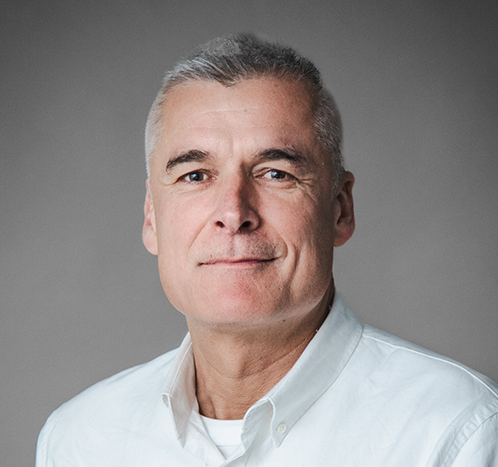
A witness to major humanitarian crises for more than twenty years, Marc Joly speaks with our colleague Yann Leclerc, Director of International Organizations, about the path that led him to strategic responsibilities at MSF in Switzerland.
A journalist in a previous life, convinced that an institution’s success rests on its ability to mobilize people around an ideal, he reflects on the lessons learned in crisis zones, the challenges of intercultural management, the changing relationship to work, and the conditions necessary for collective performance in a world defined by uncertainty.
After more than twenty years in the humanitarian sector and international organizations, what led you to undertake a master’s-level program in human resources management?
In most of the leadership roles I’ve held, human resources management represented a significant part of my work, inseparable from the conditions for good functioning. For a long time, I led intuitively. Then I began to wonder whether a more structured theoretical framework might be worthwhile. This program confirmed a number of practices I had developed empirically. It also gave me new tools and encouraged a more systemic view of human dynamics within organizations. The experience left me with one certainty: any leader responsible for overseeing a large entity must have very solid foundations in human resources management. Organizations readily invest in technical or financial skills, but they often underestimate the extent to which their performance depends, above all, on the quality of human interactions.
Looking back, what is the most striking lesson you’ve drawn from crisis zones about how organizations function?
Crisis zones teach you to distinguish between what’s essential and what’s secondary. At headquarters or in central structures, there can be a temptation to favor institutional logic. On the ground, the reality is entirely different. The overriding priority is responding to an emergency, to the immediate needs of the population. That’s probably the main lesson I’ve taken from it: crises effectively teach you how to prioritize.
At what point did you come to understand that human factors were decisive in an organization’s success or failure?
When I noticed that certain problems came from neither strategy, nor available resources, nor even processes. Sometimes all the conditions are in place for a collaboration to work, and yet it fails because the people involved simply cannot communicate with each other. With experience, you learn to identify the mechanisms at play: ego issues, poorly defined objectives, misunderstandings, or rivalries. But behind these explanations there is often something more fundamental: fear. Fear of losing a position, an influence, a form of control, or sometimes a certainty. That’s where much of the mystery of organizations lies. Structures can be rational. Human beings never entirely are.
You’ve led multicultural teams in several countries. How do you build a common culture when references, languages, and realities are so different?
There’s no universal recipe. Every environment has its own dynamics, shaped by history, society, and culture. This being said, a few conditions hold true across the board. The first requires knowing who you are. An organization must be able to articulate its values, its mission, and its identity. The second is understanding that adaptation runs both ways. We often talk about the need to adapt to others. In reality, building a shared culture requires everyone to be willing to shift some of their own reference points.
In your view, what sustains employees’ long-term commitment to a project?
Alignment between personal values and mission plays an essential role. At MSF, everyone knows what we’re trying to achieve and why we exist. But, as everywhere else, engagement also needs to be fed by more down-to-earth factors: recognition, quality of management, a sense of usefulness, the possibility of growing and contributing concretely to the collective project.
NGOs are going through a particularly difficult period. What are the main challenges they face?
MSF is funded almost entirely by private donors, so we’ve been shielded from the cuts to public funding seen in recent years. That said, we do feel the indirect effects of this situation. On the ground, some partners are disappearing for lack of resources. Interventions once handled by third-party actors now have to be taken on by our teams. The question is no longer what we can do, but what we must give up doing in order to preserve our ability to act on the most essential priorities. Humanitarian organizations operate within a funding environment that depends heavily on public trust. That trust is therefore a major strategic asset.

As Director of Communication, how do you manage the tension between the need to inform, protecting your teams, and preserving MSF’s mission?
Our communication is built above all on trust. Every day, thousands of people choose to support MSF because they believe in our ability to act and in our rigor. Yet certain operational decisions aren’t guided solely by medical considerations. They also have to take into account political, social, or community realities that determine our access to populations. Our communication then needs to explain these choices honestly, because trust, in any circumstance, is built on transparency.
What has this immersion in human resources taught you about your own approach to management?
I’m very interested in how newer generations relate to work. Career paths today are less linear; people build their trajectory through a succession of experiences rather than within a single organization. This shift forces us to rethink our employer brand culture and to develop our skills accordingly.
How would you define organizational intelligence?
If I had to define MSF’s organizational intelligence, I’d call it “effective approximation.” Organizations keep multiplying their processes, procedures, and control mechanisms. These tools are necessary, certainly, but they should remain a guiding thread, not an end in themselves. Organizational intelligence means knowing when to step away from them, when to accept moving outside the theoretical framework in order to produce a concrete result.
What advice would you give to a leader facing a major transformation of their organization?
I would first recommend clarifying the “why,” because employees need to understand what justifies the transformation: what developments are driving it, what problems it aims to solve, what resources it will help preserve or use more effectively. When change is grounded in coherent, explainable reasoning, it becomes possible to have a constructive discussion. A leader’s credibility therefore rests more on the quality of their reasoning than on their ability to secure immediate consensus.
What makes you optimistic about organizations’ ability to face crises that are increasingly shaped by geopolitics?
What concerns me today isn’t a lack of solutions, but the growing fragmentation of societies. Digital technologies have expanded our access to information, but they’ve also fostered the emergence of parallel worlds that communicate with each other less and less. Our challenge will be to create and nurture spaces for dialogue around shared goals. I remain confident in humanity’s capacity to cooperate when the stakes become significant enough. In situations of extreme urgency, people always find extraordinary collective resources.


“Structures can be rational. Human beings never entirely are.”
Marc Joly, Director of Communication and Fundraising at Médecins Sans Frontières Switzerland (MSF)
Contact us
Write to usFollow us on LinkedIn
Follow usLearn more
A look back at the inauguration of our Lausanne offices, Thursday 8 October
Discover what this day was made of, and what gave it its rhythm....
The role of human resources in business agility: recruitment, training and evaluation in the age of adaptability
Recruitment, training and employee evaluation in business agility....
 Ad Valoris répond