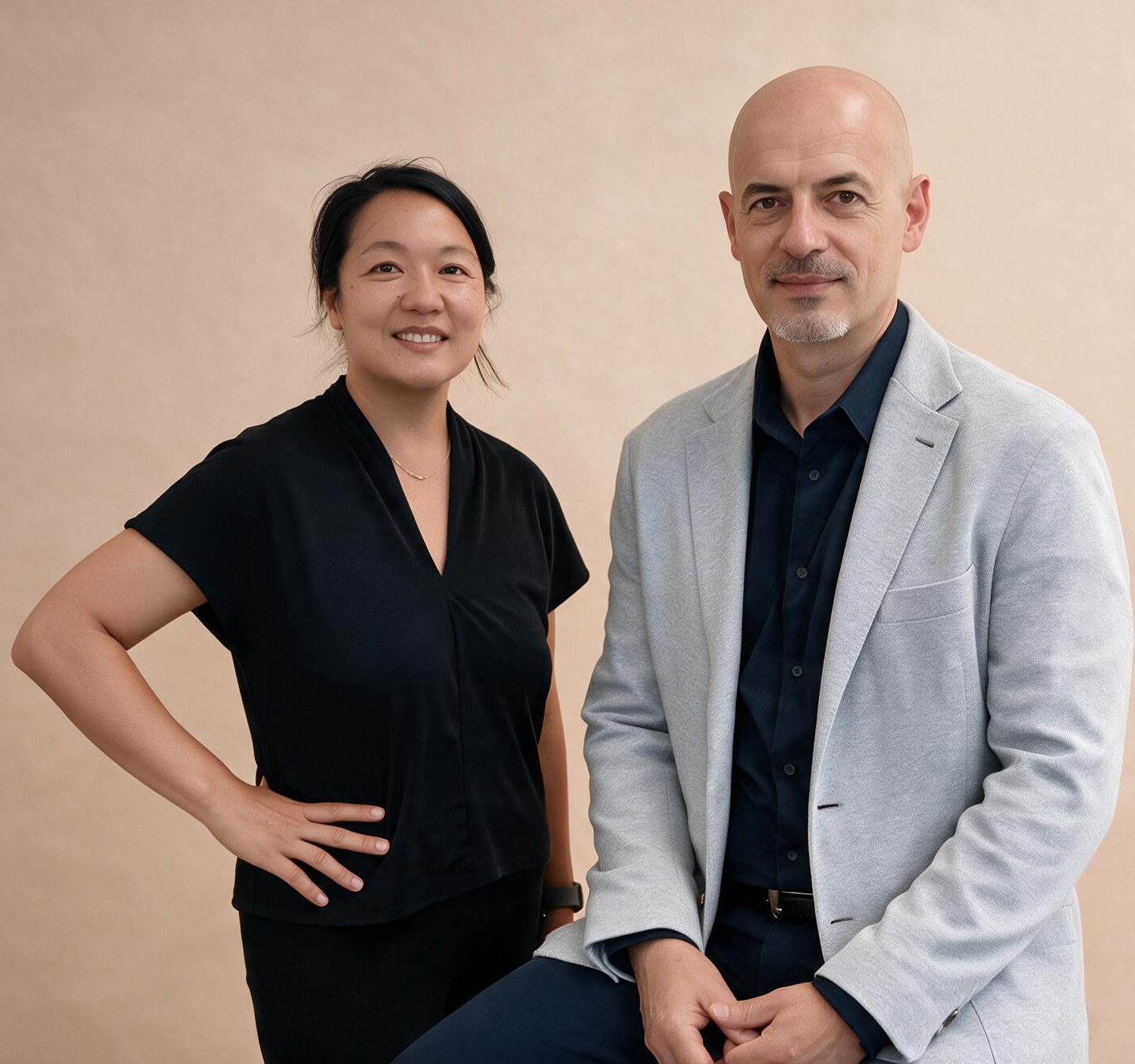
Ad Valoris is opening new offices in Lausanne. An opportunity to speak with Sophie Tijeras, Associate Director, and Thierry Ungaro, Founding Partner, who lead the firm together, about what makes this new step possible: sixteen years travelled side by side.
This new chapter owes nothing to chance. It extends a conviction: that supporting the organizations of French-speaking Switzerland happens in the field, as close as possible to their reality. Above all, this event belongs to a longer story, that of a duo who have moved forward in step for sixteen years.
For the occasion, Sophie Tijeras and Thierry Ungaro agreed to a joint interview. They recount the birth of Ad Valoris, a strategy consulting firm that came into the world without a business plan or a strategic plan; the irony is not lost on them. Above all, they reveal what allows a leadership duo to endure: constant dialogue, the veto rule, and a relational framework cultivated from the very beginning.
In 2026, Ad Valoris is opening new offices in Lausanne, nine years after those in Geneva. Why this new step?
Thierry Ungaro. It is first of all an obvious conclusion drawn from the field, rather than a strategy calculated long in advance. A growing share of our engagements takes place in the canton of Vaud, and we are deeply convinced that consulting cannot be practiced from a distance: it happens on site, alongside the teams. From there, there is no reason to confine ourselves to a territory bounded by a line on a map, when twenty kilometers away companies and institutions are going through the same dynamics of transformation.
Sophie Tijeras. Local roots matter a great deal to us. A visible presence in Lausanne brings us closer to our clients in Vaud and allows us to attract employees based in the canton.
How did this project come about?
Thierry Ungaro. In 2023, Sophie and I sat down to consider the direction we wanted to give the firm. Our previous strategic plan aimed at a firm of fifteen to twenty employees, recognized for its excellence, and that vision had been achieved on almost every count. One choice remained: to consolidate the firm as we had built it, a more predictable path though no easier, or to take the road of geographic and sectoral expansion, with its share of uncertainty, construction and challenge. We chose the second, with a new vision: a firm of thirty to forty employees, established across three to four sites in Switzerland. After Geneva, Lausanne is the first step.
This event is also an opportunity to look back at the beginnings of Ad Valoris. How was the firm born?
Thierry Ungaro. At the outset there was no business plan, no fundraising, no five-year projections. There was a deep conviction: our positioning would succeed, because the demand was there. I first practiced alone, for four or five years, until the day the work exceeded what one person can absorb. A mutual acquaintance then introduced me to a consultant, Sophie. We met over a coffee and, quite clearly, she was the one interviewing me for the job. Our collaboration began in 2010, and Ad Valoris was born in its wake, in 2011.
Sophie Tijeras. I knew fairly quickly what I was looking for: to work as a consultant on engagements and, at the same time, to contribute to building something. The day I told Thierry, his answer was immediate: “Come and do it at Ad Valoris.” In the early years there were four or five of us consultants, each absorbed by our own engagements, organized in a star around Thierry. Together with another consultant, I then proposed that we draw up the strategic plan for Ad Valoris. His answer was true to who he is: “Think about it, come back to me with something.” We returned with proposed actions: create a visual identity, a website, build a team dynamic, rent our first offices, and he said yes to all of it. That is how we moved from a star-shaped arrangement to a genuine company.
“Quite clearly, she was the one interviewing me for the job.”
Thierry Ungaro, Founding Partner
In that same vein, how did your duo form, and how has it been built over the years?
Thierry Ungaro. The pairing was first built in the very substance of the work: client sessions and their preparation. It was the craftsman and the apprentice. Out of that daily practice came a very strong convergence of views, which the years have only reinforced: for a long time, we ran every engagement together.
Sophie Tijeras. We first got to know each other professionally, very quickly, in a supervisory relationship on engagements that worked very well. When I joined the leadership, we learned to know each other differently, as two members of the same leadership team. In the same movement, we learned to express our substantive disagreements constructively.
Clients and employees alike describe you as two very different personalities. How do you complement each other?
Thierry Ungaro. I would say that I bring a direction and projections, and that Sophie structures and organizes what I set in motion. Beyond that complementarity, she is the sparring partner against whom I test my ideas. Sitting down, drawing diagrams, examining together what would happen if we took one direction rather than another: the exercise is infinitely easier, and more interesting, with two people than alone.
Sophie Tijeras. What Thierry brings me is both vision and a permanent capacity to question what exists. Nothing is ever settled: everything can be rediscussed, reopened, improved, always with a view to moving forward. In the end, we have no limits other than those we set for ourselves. For our clients, we can go as far as our thinking carries us; internally, if a better idea emerges tomorrow, we can adjust everything while holding our course. It is a mindset I have come to absorb, well beyond the professional sphere.
“We have no limits other than those we set for ourselves.”
Sophie Tijeras, Associate Director

Consulting cannot be practiced from a distance: it happens on site, alongside the teams.

Sixteen years as a pair implies knowing how to pass through turbulence. How do you face uncertainty, whether it is an economic climate that turns or a major unforeseen event?
Thierry Ungaro. We have never known “difficulties” in the dramatic sense of the word, meaning that we have never found ourselves on the edge of the abyss or at a dead end. There have been events to manage, more or less easy ones, and that is the normal life of a growing company. The hardest thing to take in lay elsewhere: understanding that the company’s project outlasts the individuals. We were very good at managing beginnings, less so at managing endings, because I had intimately tied the team to the company’s project. My discussions with Sophie moved me forward: the company needs a project of its own, a project that carries employees along without ever being confused with them.
Sophie Tijeras. We work on the principle that nothing can really be predicted: a major unforeseen event is nothing other than ordinary life. It is not panic, it is a new input. We pause, we measure the impacts, we initiate the first actions, then we adjust. Covid illustrates this: we did not try to anticipate ten moves ahead, only to decide the next step.
Thierry Ungaro. For years, our end-of-year greetings revolved around the same idea: in the end, it is never the inevitable that happens, it is the unexpected.
“In the end, it is never the inevitable that happens, it is the unexpected.”
Thierry Ungaro, Founding Partner
And how do you act when you disagree?
Thierry Ungaro. From the outset we set a non-negotiable rule: the veto. If one of us uses it, the discussion stops and we change the angle. In sixteen years, it has been used only once or twice, and it has never left any frustration: it is the rule of the game, accepted on both sides, and it guarantees a perfect balance since there is no hierarchy in our discussions. Day to day, a problem is never my problem or Sophie’s: it is our situation to handle.
Sophie Tijeras. Our discussions bear on substance, never on the people we are: they are debates of opinion, not conflicts. Of course, some situations are emotionally more demanding than others, and what we have learned is to put things into words in every case. Thierry is able to do so in the moment; I have learned to do it either in the moment or afterwards. Because he is open to any feedback expressed with respect, we have always been able to say everything to each other.
Opening a site is a major decision, a milestone in the history of Ad Valoris. How did you move from a decision of that size, and the doubts that come with it, to action?
Sophie Tijeras. We did not experience it as an enormous decision: it is the continuation of an intention. One day, you tell yourself that the next step is Lausanne. We ran our figures, looked for offices and, at a certain point, took the step, because until you take it, you do not know. Our weekly meetings simply revalidated the intention along the way: is this still what we want? Nothing had changed enough, internally or externally, to make us change our minds. So we went ahead.
Thierry Ungaro. This is our method of small steps: rather than a perfect five-year plan, one question, always the same: what do we do over the first six months? It comes with a permanent permission, that of questioning the direction again as we go.
On the Lausanne project as in everyday work, how do you divide the roles?
Sophie Tijeras. The division follows our affinities with the subjects and is consistent with our usual roles. Our perimeters are distinct but porous: Thierry deals more with the outside and with business development, I deal more with the inside and with the development of our people. Since the opening in Lausanne contributes largely to our external development, he naturally carried the project.
Thierry Ungaro. Each of us carries the subjects we wish to carry, and whoever carries an idea moves forward as long as there is no veto. The first concrete step in Lausanne followed from that: that one of us should take it on and begin the search for premises.
What advice would you give to two leaders starting out today as a pair?
Thierry Ungaro. We are wary of advice: every pair is singular, and each lives its own experience. If we nevertheless had to share ours, it would first be this: talk to each other. About yourselves, about the profession, about life, about your values. And listen truly to what the other says, in order to understand rather than to reply. Mental representations evolve constantly: whoever holds on to a fixed image of what the other thinks ends up drifting away from it, and that readjustment should not wait more than a week or two. Our experience has also taught us the value of boundaries. We do not go on holiday together and we maintain no intimacy other than a professional one: that deliberate choice preserves the perspective and the free will of each of us.
Sophie Tijeras. I hold on to that distance a great deal. Thierry is probably, after my husband, the person who knows me best. The important things, of course, we share; the rest belongs to each of us, and that is just as it should be.
And if you had to sum up these sixteen years in one sentence each?
Thierry Ungaro. You are mistaken: it has not been sixteen years, it has been three weeks.
Sophie Tijeras. A journey that looks like us.


“We have no limits othen than those we set for ourselves“
Sophie Tijeras and Thierry Ungaro, Ad Valoris’s leadership
Contact us
Write to usFollow us on LinkedIn
Follow usLearn more
A conversation with Ad Valoris’s leadership, Sophie Tijeras and Thierry Ungaro, marking the opening of the Lausanne offices
Ad Valoris opens offices in Lausanne in 2026
Ad Valoris opens offices in Lausanne, in the Edipresse Tower, avenue de la Gare 33....
 Ad Valoris répond