Born in Osaka in 1932 with the creation of an adhesive for bicycle tyres, Sunstar is today an international group active in oral healthcare as much as in industrial applications. An almost century-old Japanese company whose global centre of gravity now lies in Switzerland, in Etoy.
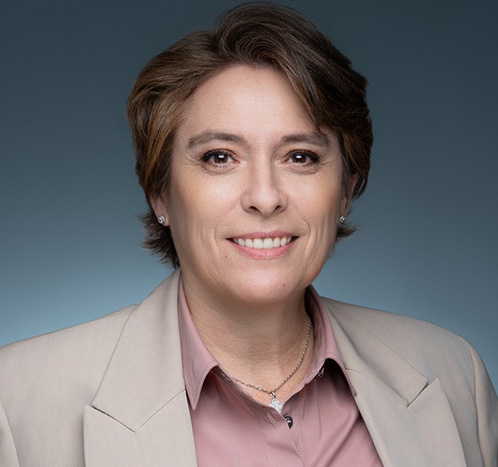
It is in this singular environment that Agnès Dumolard leads a transformation mission reaching far beyond the deployment of new tools or processes. She shares her experience of it alongside our colleague Yann Leclerc, Director of International Organisations. An engineer by training, whose career includes the Cartier group, she must bring together professions, continents and cultures that neither think nor decide in the same way. With one conviction: transforming an organisation is first and foremost a matter of choices, of influence and of people. A conversation with a leader who underestimates neither the difficulty of her mission nor the risks it carries.
You spent a significant part of your career with the jeweller Cartier before joining Sunstar. What led you from one world to the other?
The products obviously have nothing in common, but what interested me is precisely what lies behind the product. In the luxury industry, there is an iron discipline in the pursuit of excellence. I found similar values at Sunstar: discipline, quality, respect, exacting standards. I could have chosen a more familiar environment, but what appealed to me here was, on the contrary, the complexity: an almost century-old Japanese company whose global headquarters are in Switzerland, at the crossroads of very different cultures.
Why did Sunstar choose to establish its global headquarters in Switzerland?
There was first a desire to secure the company’s future by opening it to the world. Remaining confined to Japan would have limited its development. Switzerland offered several advantages: its stability, the quality of its resources, its geographical position and, in a certain way, its ability to stand between several cultures. But moving a headquarters is obviously not enough to make a company global. Sunstar has grown internationally while remaining culturally very Japanese. One of the challenges today therefore consists in bringing together entities that grew up in very different environments and leading them to move in the same direction. That calls for technical changes, of course, but also for far deeper work on the ways of deciding, collaborating and understanding one another.
“But moving a headquarters is obviously not enough to make a company global.”
Sunstar brings together two very different worlds, “Consumer” and “Industrial”. Are you being asked to build a common operating model?
Yes, even if the aim is not to standardise everything. The question is rather to identify what we can share in order to gain efficiency and support growth: practices, data, certain processes, the way decisions are made or projects steered. When I joined Sunstar, my initial remit concerned data above all. I gradually proposed building a more cross-cutting function, because structuring data, in itself, is not the hardest part. The real difficulty lies in assembling the pieces, creating communities and bringing different organisations into alignment.
Why does Sunstar feel the need to accelerate its transformation today?
Because its environment has changed. The group has a strong industrial culture: historically, the conviction was that well-designed products, backed by research and meeting high quality and safety requirements, would naturally find their market. Yet competition has intensified and distribution channels have evolved. In Japan in particular, the rise of online commerce has opened the market more widely to international competitors. In the industrial business, the transformation of the automotive sector and the rise of China create further challenges. The model that made Sunstar successful must therefore evolve. The Executive Committee has, moreover, brought in several leaders with solid experience of large international groups. The challenge now is to transform the organisation without losing what makes it strong.
Transformation is readily presented as the adoption of new systems. But transforming also means giving things up. What must one know how to give up?
First of all, the idea that one can do everything. When resources are limited, you have to choose the initiatives that will genuinely create value. It is a constant discipline: arbitrating between what would be ideal and what is possible. Transforming is therefore not about changing everything. It is also about knowing what you will not do.
How do you achieve real change when you have a cross-cutting view and a mandate from the Executive Committee, but not necessarily direct authority over those who must change?
I use the strength of others, rather in the manner of a judoka. When I lack the authority to set things in motion directly, I look for the right levers within the organisation. I build alliances, I test my ideas with small communities, I observe the way they make their way. And when a blockage is real, I can rely on the Executive Committee so that the impetus comes from above. That said, what works with Americans does not necessarily work with Japanese colleagues. Direct confrontation, for example, can be very badly received in Japan. I have had to learn to adapt the way I exert influence.
“I use the strength of others, rather in the manner of a judoka.”
Is this ability to influence without imposing a method or a personal disposition?
It is largely experience. I have learned methods and taken courses, but experience above all teaches you how to translate a strategy into the reality of an organisation. And then I rather like risk! Considered risk. I test a great deal. I try to move forward without unnecessary confrontation, observing reactions and adapting the way I work. If 50% of what we undertake genuinely comes to fruition, that will already be a success.


Sunstar remains deeply marked by its Japanese culture. How do you distinguish what must be transformed from what must be preserved?
That is precisely one of the difficulties. In the West, we sometimes tend to regard our own way of operating as the norm. I myself can find myself wanting to impose a solution because it seems obvious to me, then realising that I have not sufficiently taken Japanese culture into account. Transforming therefore does not mean westernising Sunstar. We must build something that allows different cultures to work together without asking each of them to give up what it is.
“In the West, we sometimes tend to regard our own way of operating as the norm.”
You maintain that the human dimension of change determines a transformation’s ability to create value. How do you prevent that from remaining a mere formula?
By looking at what happens when it is forgotten. Building a new organisation chart is very simple. So is modifying processes on paper. Bringing them to life is far harder, because at the end of the chain it is always people who produce value. I have seen organisations want to wipe the slate clean too quickly. People leave, skills disappear, the culture unravels and results eventually suffer. Systems can make an organisation far more efficient. But if employees do not trust them, if they do not understand what they are doing and why they are doing it, the system does not work.
Artificial intelligence is precisely unsettling that boundary between the human and the machine. Can one still design an operating model for three or five years ahead?
We must of course anticipate AI, but by starting with a very simple question: what will it genuinely bring us? We are currently at the peak of a curve of enthusiasm. That does not mean AI is not a major transformation. It is, and it will create considerable opportunities. But we must distinguish what genuinely creates value from what is a matter of fashion. I worked on artificial intelligence topics a long time ago already, after my studies at EPFL. The concepts are not all new. What has changed today is their power and their accessibility. “Putting people at the centre” therefore does not mean refusing technology. It means knowing why we use it and preserving our capacity for judgement.
Do you fear failure?
Of the results, no. What concerns me more is how to preserve my energy and hold the course. A transformation demands a great deal of constancy, because the environment changes all the time and some days can be emotionally difficult. I have also learned to set limits. I am not going to attend a meeting at two in the morning simply because it exists. When I was younger, I probably believed, like many people, that working ever harder was the condition for progressing. With experience, you come to understand that what allowed you to reach a certain level is not necessarily what will allow you to go further.
“I am not going to attend a meeting at two in the morning simply because it exists.”
You have known Japan for more than twenty years. What continues to strike you about that culture?
The first time I arrived in Japan, what struck me was the calm. The attention paid to serenity, the relationship with nature, but also the communal dimension. Japan is a country that has learned to live collectively. Giving to the community or to the company remains extremely present. Even with the standardisation of the world, that culture remains very strong. Westerners have other qualities. We are probably more creative, more inclined to question ourselves. The interest lies precisely in that encounter. I have always enjoyed working with different cultures, because they force you to question what you took for granted.
Finally, what do you still expect from your career?
To continue doing things difficult enough to learn from, and then to be able to pass on what I have learned.

“Systems can make an organisation far more efficient. But if employees do not trust them, if they do not understand what they are doing and why they are doing it, the system does not work.”
Agnès Dumolard, Director, Group Transformation Office at the Sunstar Group
Contact us
Write to usFollow us on LinkedIn
Follow us Ad Valoris répond